Why a child should know the art of their own district
A ten-year-old in Madhubani thought Mithila painting was Japanese. That answer is not her fault, and it tells us exactly what schooling taught her to value.
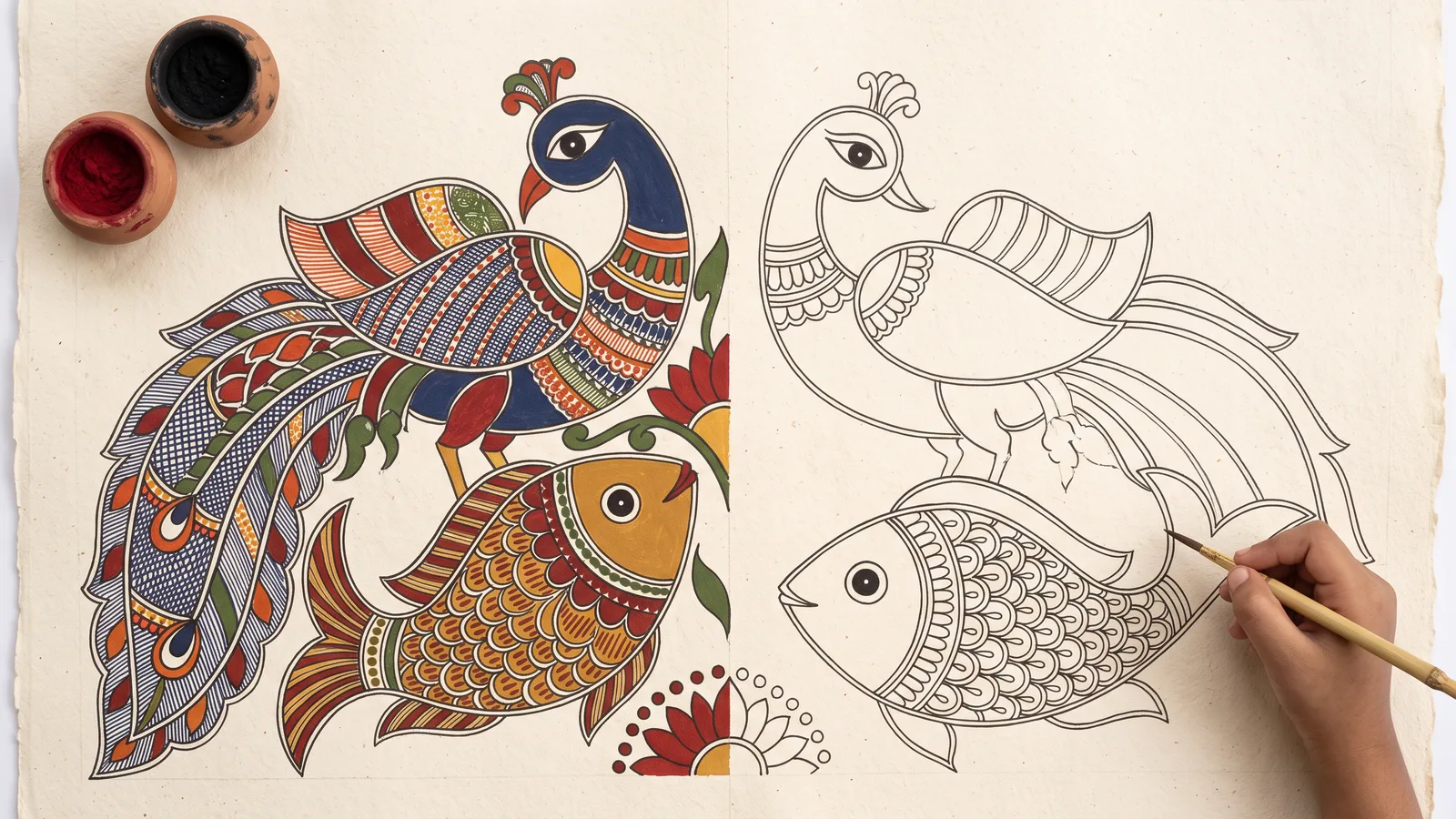
We were in a classroom in Madhubani district — the place the painting is named after — showing children images and asking them to say what they saw. One painting was unmistakably Mithila work: the double outline, the fish, the fill-every-inch density. A girl of about ten looked at it for a while and said she thought it was from Japan.
I want to be careful about how that story is read. It is not a story about a child being ignorant. She was reasoning perfectly well from the evidence available to her. Nothing in her schooling had ever suggested that the painting tradition of her own district was the kind of thing that turns up in a classroom, gets named, or matters. Ornate, careful, foreign-looking art must therefore come from somewhere else — somewhere that makes art worth naming.
What the curriculum quietly teaches
A syllabus teaches two things at once. There is the content, and then there is the much stronger lesson carried by what got included at all. Eleven years of schooling that never mentions Mithila painting has taught a very clear lesson about Mithila painting, and it did not need to say a word.
This is why we are unconvinced by the argument that culture will take care of itself at home. It might have, once, when the transmission was intact. But home is now competing with twelve hours a day of schooling and screens that both point the other way, and a grandmother telling a story once a week is not a fair fight.
The specific before the general
When we started, we assumed we would teach “Indian art” — a survey, a bit of everything, a national picture. That was wrong, and the children corrected us quickly.
A survey produces polite interest. Teaching the form made in your own district, by someone who makes it, produces something else entirely: recognition. Children go home and find the same motifs on a wall they have walked past their whole lives. One boy in our Bihar cohort discovered that his own great-aunt painted, which nobody had thought worth mentioning to him.
That is the moment the work turns. Not “India has a rich artistic heritage,” which is a sentence a child can repeat without believing. Instead: this is ours, it is on my wall, and my great-aunt makes it.
What it asks of us
Teaching the specific is harder and more expensive. It means finding a practising artist in each region rather than writing one manual for everybody. It means the Odisha curriculum is not the Bihar curriculum. It means we cannot scale the way a textbook scales.
We think it is worth it, because the alternative is the thing we already have — a generation who can name the art of everywhere except the place they live.
Written by Folksutra. Reply tofolksutra.official@gmail.com — we read everything.